Wikipedia
This text was copied from Wikipedia on 2 May 2024 at 5:10AM.
Brielle
Brill | |
|---|---|
City | |
 Historic city centre | |
 Flag  Coat of arms | |
.svg) Location in South Holland | |
| Coordinates: 51°54′N 4°10′E / 51.900°N 4.167°E / 51.900; 4.167 | |
| Country | Netherlands |
| Province | South Holland |
| Municipality | Voorne aan Zee |
| Area | |
| • Total | 31.14 km2 (12.02 sq mi) |
| • Land | 27.55 km2 (10.64 sq mi) |
| • Water | 3.59 km2 (1.39 sq mi) |
| Elevation | 2 m (7 ft) |
| Population (January 2021)[3] | |
| • Total | 17,439 |
| • Density | 633/km2 (1,640/sq mi) |
| Demonym | Briellenaar |
| Time zone | UTC+1 (CET) |
| • Summer (DST) | UTC+2 (CEST) |
| Postcode | 3230–3232 |
| Area code | 0181 |
| Website | www.brielle.nl |

Brielle (pronounced [ˈbrilə] ⓘ), also called Den Briel in Dutch and Brill in English, is a town and historic seaport in the western Netherlands, in the province of South Holland, on the north side of the island of Voorne-Putten, at the mouth of the New Maas. The former municipality covered an area of 31.14 km2 (12.02 sq mi) of which 3.59 km2 (1.39 sq mi) was water. In 2021 its population was 17,439.
The former municipality of Brielle also included the communities of Vierpolders and Zwartewaal.
On 1 January 2023, the municipality of Brielle merged with Hellevoetsluis and Westvoorne into the new municipality of Voorne aan Zee.
History
 |
Brielle is a very old, fortified city. Its name is derived from the Celtic word brogilo (meaning "closed area" or "hunting grounds"). The oldest writings about Brielle indicate that the current location is the "new" Brielle. Den ouden Briel (Old Brill) must have been situated somewhere else on the Voorne-Putten Island. It received city rights in 1306. The city was for a long time the seat of the Count of Voorne, until this fiefdom was added to Holland in 1371. It had its own harbour and traded with the countries around the Baltic Sea. Brielle even had its own trading colony in Sweden.
.jpg)
During the Eighty Years' War between the Netherlands and Spain, the Capture of Brielle on April 1, 1572, by Protestant rebels, the Watergeuzen, marked a turning point in the conflict, as many towns in Holland then began to support William of Orange against the Spanish Duke Fernando Álvarez de Toledo, 3rd Duke of Alba who was sent to pacify The Netherlands. This event is still celebrated each year on April 1 and the night before (known as Chalk Night (kalknacht) when the city is defaced with chalk - and now also white paint). Dutch students are taught a short rhyme to remember this fact, which rhyme refers to April Fools' Day:
|
|
In Dutch, "de bril" is the word for "the glasses," and closely rhymes with Den Briel; as does "Fles" which stands for the town of Vlissingen or Flushing, the next town to be captured by the Dutch rebels.
After the capture of Brielle the Protestant rebels tortured and murdered the Catholic Martyrs of Gorkum and Brielle has become a pilgrimage location since then.
In August 1585, Brielle was one of the three Dutch towns that became an English possession by the Treaty of Nonsuch when Queen Elizabeth I received it as security of payment for 5000 soldiers (led by the Earl of Leicester) and used by the Dutch in their struggle against the Spanish. The first English governor of Brielle was Thomas Cecil, 1st Earl of Exeter, succeeded by Edward Conway, 1st Viscount Conway who named his daughter Brilliana in honour of the city. English garrisons were stationed here and at Flushing.[4] In 1617, these cities returned to the Netherlands.
Twin cities
Brielle is twinned with:
|


Notable people
,_by_Abraham_van_Westerveldt.jpg)
- Anneke Esaiasdochter (1509 in Brielle – 1539), a Dutch Anabaptist executed as a heretic, a Protestant martyr.
- Willem Bloys van Treslong (1529–1594), a nobleman, lead the Sea Beggars and the Capture of Brielle in 1572.
- Maarten Tromp (1598 in Brielle – 1653), a Dutch army general and admiral in the Dutch navy
- Witte de With (1599 in Hoogendijk – 1658), a Dutch naval officer during the Eighty Years War and the First Anglo-Dutch war
- Ludowyk Smits (1635 in Zwartewaal – 1707), a Dutch Golden Age painter
- Philips van Almonde (1644 in Den Briel – 1711), a Dutch Lieutenant Admiral
- Constantijn van Daalen (1884 in Brielle – 1931), a Dutch gymnast who competed in the 1908 Summer Olympics
- Toon Tellegen (born 1941 in Brielle), a Dutch writer and poet, known for children's books and a physician
See also
Gallery
-
 Brielle, church: de Sint Catharijne kerk
 -
 Brielle, monumental houses at the Wellerondom
 -
 Brielle - panoramio
 -
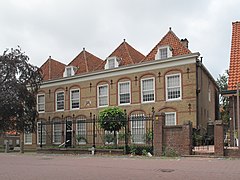 Brielle, former orphanage
 -
 Brielle, monumental houses Vischstraat


References
- ^ "Kerncijfers wijken en buurten 2020" [Key figures for neighbourhoods 2020]. StatLine (in Dutch). CBS. 24 July 2020. Retrieved 19 September 2020.
- ^ "Postcodetool for 3231AP". Actueel Hoogtebestand Nederland (in Dutch). Het Waterschapshuis. Retrieved 16 July 2013.
- ^ "Bevolkingsontwikkeling; regio per maand" [Population growth; regions per month]. CBS Statline (in Dutch). CBS. 1 January 2021. Retrieved 2 January 2022.
- ^ Garrett Mattingly (1959), The Armada, Boston: Houghton Mifflin, Ch. V, "Plans of Operations", p. 44.
External links


- Official website (some pages in English)
- http://www.catharijnekerk.nl Website of St Catharijnekerk
3 Annotations
First Reading
Michiel van der Leeuw • Link
Brielle is a very famous town in Dutch history. On april 1st 1572 it was the first city that, almost by accident, got in control of the rebels against the Spanish government. This is still remembered in Brielle on every april 1st.
danny kidd(corky) • Link
i lived in holland for 4 years working as a scaffolder. i stayed in brielle and would recomend it as a good place for a holliday.its a very historic fortifide town with many good bars try the porthouse(over the road from the honky tonk)...ask if they knew corky
Third Reading
San Diego Sarah • Link
Brielle is a historic and fortified seaside town in the Western Netherlands, about 35 km from Rotterdam.
It's a town with a long and prominent history.
It played a crucial role in the Eighty Years' War, as the Capture of Brielle by the so-called Watergeuzen (or Sea beggars, the Dutch rebels) on 1 April 1572 became the beginning of massive Dutch uprising against Spain.
A major part of the village's historic heritage is situated within the old defensive walls, so navigating your way on foot is easy. With some 400 buildings and structures on the national heritage list, there's no way to escape some cultural sightseeing in this charming little town.
The main star-shaped structure of defensive walls and canals has changed little since their construction in 1713, making Brielle one of the best preserved fortified towns in the Netherlands. The 9 bastions and 5 ravelins were restored in the 1970s and several of the original city gates are still present.
The Grote of Sint-Catharijnekerk. This massive church would have been the largest in Holland of that time, but the structure was never completed. Building started in 1417 but the last bricks were added in 1482, when only the main nave and a 57-m tower was completed. A stained glass window depicts the wedding of William I of Orange and his third wife, which took place here in 1575, after the church was looted and turned into a Protestant church during the Dutch Reformation. It's possible to climb the stairs of the tower, for a nice view over the town
Brielle today is a charming town with one of the highest per capita counts of monuments in the country.
Brielle isn't far from touristic hotspots Rotterdam (known for its modern architecture) and historic Delft. If you'd rather see more of the Dutch seaside, go on island hopping on the Zuid-Hollandse Eilanden and head on to Zierikzee, Middelburg or Vlissingen, maybe stopping on route to see some of the Delta Works.
If you're more in the mood for nature, consider a visit to the Biesbosch National Park.
https://en.wikivoyage.org/wiki/Br…