Wikipedia
This text was copied from Wikipedia on 25 April 2024 at 3:10AM.
The Earl of Nottingham | |
|---|---|
 The Earl of Nottingham by Sir Godfrey Kneller, Bt, c. 1680 | |
| Lord Chancellor | |
| In office 1675–1682 | |
| Preceded by | The Earl of Shaftesbury |
| Succeeded by | Sir Francis North |
| Lord Keeper | |
| In office 1673–1675 | |
| Preceded by | The Earl of Shaftesbury |
| Succeeded by | Sir Francis North |
| Attorney General | |
| In office 1670–1673 | |
| Preceded by | Sir Geoffrey Palmer, Bt |
| Succeeded by | Sir Francis North |
| Solicitor General | |
| In office 1660–1670 | |
| Preceded by | William Ellis |
| Succeeded by | Sir Edward Turnour |
| Member of Parliament for Oxford University | |
| In office 1661–1674 Serving with Laurence Hyde | |
| Preceded by | Thomas Clayton John Mylles |
| Succeeded by | Laurence Hyde Thomas Thynne |
| Member of Parliament for Canterbury | |
| In office 1660–1660 Serving with Sir Anthony Aucher | |
| Preceded by | Sir Edward Master John Nutt |
| Succeeded by | Francis Lovelace Sir Edward Master |
| Personal details | |
| Born | Heneage Finch (1620-12-23)23 December 1620 Eastwell, Kent |
| Died | 18 December 1682(1682-12-18) (aged 61) Great Queen Street, London |
| Spouse |
Elizabeth Harvey
(after 1646) |
| Parent(s) | Sir Heneage Finch Frances Bell Finch |
| Education | Westminster School |
| Alma mater | Christ Church, Oxford |
Heneage Finch, 1st Earl of Nottingham, PC (23 December 1620 – 18 December 1682), Lord Chancellor of England, was descended from the old family of Finch, many of whose members had attained high legal eminence, and was the eldest son of Sir Heneage Finch, Recorder of London, by his first wife Frances Bell, daughter of Sir Edmond Bell of Beaupre Hall, Norfolk.[1]
Early career
In the register of Oxford University, he is entered as born in Kent, and probably his native place was Eastwell in that county. He was educated at Westminster and at Christ Church, Oxford, where he remained until he became a member of the Inner Temple in 1638. He was called to the bar in 1645, and soon obtained a lucrative practice.[1]
Career
In April 1660, he was elected Member of Parliament for Canterbury and Mitchell in the Convention Parliament and chose to sit for Canterbury.[2] Shortly afterwards he was appointed Solicitor General, in which capacity he served as the prosecutor of the regicides of Charles I, and was created a baronet the day after he was knighted. In May 1661 he was elected MP for Oxford University in the Cavalier Parliament.[2] In 1665 the university created him a D.C.L. In 1670 he became Attorney General, and in 1675 Lord Chancellor. He was created Baron Finch in January 1673 and Earl of Nottingham in May 1681.[3]
Popish Plot
During the Popish Plot, he played an active part in the interrogation of witnesses and preparation of the Crown's evidence. He is said to have been sceptical about the credibility of much of the evidence, and drew up a private report referring to the difficulties with Titus Oates' testimony.[4] In general he behaved with moderation and restraint during the Plot, as shown most notably in his impartial conduct, as Lord High Steward, of the trial of William Howard, 1st Viscount Stafford, (apart from a curious remark that it was now clear that the Great Fire of London was a Catholic conspiracy).[5] Kenyon notes that during the examination of the informer Miles Prance, Finch threatened him with the rack,[6] but such a lapse was most uncharacteristic of Finch, who was a humane and civilised man; in any case, the threat could hardly have been serious since the use of the rack had been declared illegal in 1628.
Finch and Nottingham House, now Kensington Palace
The original early 17th-century building was constructed in the village of Kensington as Nottingham House for the Earl of Nottingham. It was acquired from his heir, who was Secretary of State to William III, in 1689, because the King wanted a residence near London but away from the smoky air of the capital, because he was asthmatic. At that time Kensington was a suburban village location outside London, but more accessible than Hampton Court, a water journey on the Thames. A private road was laid out from the Palace to Hyde Park Corner, broad enough for several carriages to travel abreast, part of which survives today as Rotten Row. The Palace was improved and extended by Sir Christopher Wren with pavilions attached to each corner of the central block, for it now needed paired Royal Apartments approached by the Great Stairs, a council chamber, and the Chapel Royal. Then, when Wren re-oriented the house to face west, he built north and south wings to flank the approach, made into a proper cour d'honneur that was entered through an archway surmounted by a clock tower. Nevertheless, as a private domestic retreat, it was referred to as Kensington House, rather than "Palace". The walled kitchen gardens at Kensington House supplied fruits and vegetables for the Court of St. James's.[7]
Personal life
On 30 July 1646, he was married to Elizabeth Harvey, daughter of William Harvey's younger brother Daniel, and his wife Elizabeth Kinnersley.[8] Together, Elizabeth and Heneage were the parents of six children, including:[9]
- Daniel Finch, 2nd Earl of Nottingham (1647–1730), who married Lady Essex Rich.[10]
- Margaret Finch (1648–1700), who married Denis MacCarthy of the MacCarthy Reagh.[8]
- Heneage Finch, 1st Earl of Aylesford (c. 1649–1719), who had a distinguished career as a lawyer and politician and was Solicitor General 1679–86.[11]
- Elizabeth Finch (1650–1675), who married Sir Samuel Grimston, 3rd Baronet.[8]
- William Finch[8]
- Charles Finch[12]
Lord Nottingham died in Great Queen Street, London on 18 December 1682. He was buried in the church of Ravenstone in Buckinghamshire. His son Daniel inherited his earldom, and would later also inherit the Earldom of Winchelsea.[10]
Character
According to the Encyclopædia Britannica Eleventh Edition, his contemporaries on both sides of politics agree in their high estimate of his integrity, moderation and eloquence, while his abilities as a lawyer are sufficiently attested by the fact that he is still spoken of as the father of equity. His most important contribution to the statute book is The Statute of Frauds. While attorney-general he superintended the edition of Sir Henry Hobart's Reports (1671). He also published Several Speeches and Discourses in the Tryal of the Judges of King Charles 1. (1660); Speeches to both Houses of Parliament (1679); Speech at the Sentence of Viscount Stafford (1680). He left Chancery Reports in MS., and notes on Coke's Institutes.[13]
-
 Arms of Finch: Argent, a chevron between three griffins passant sable
 -
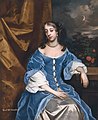 His daughter Elizabeth (Peter Lely)

,_by_Peter_Lely.jpg)
References
- ^ a b Chisholm 1911, p. 824.
- ^ a b History of Parliament Online - Finch, Heneage
- ^ Chisholm 1911, pp. 824–825.
- ^ Kenyon, J.P. The Popish Plot Phoenix Press Reissue 2000 p. 86
- ^ Kenyon p. 232
- ^ Kenyon p. 153
- ^ Chisholm, Hugh, ed. (1911). . Encyclopædia Britannica. Vol. 15 (11th ed.). Cambridge University Press. p. 733.
- ^ a b c d Power, D’Arcy: "William Harvey", Longmans Green & Co., New York, 1898, Page 7.
- ^ "Nottingham, Earl of (E, 1681)". cracroftspeerage.co.uk. Heraldic Media Limited. Retrieved 30 January 2020.
- ^ a b "Winchilsea, Earl of (E, 1628)". cracroftspeerage.co.uk. Heraldic Media Limited. Retrieved 30 January 2020.
- ^ "Aylesford, Earl of (GB, 1714)". cracroftspeerage.co.uk. Heraldic Media Limited. Retrieved 30 January 2020.
- ^ 'Faber-Flood', in Alumni Oxonienses 1500-1714, ed. Joseph Foster (Oxford, 1891), pp. 480-509. British History Online http://www.british-history.ac.uk/alumni-oxon/1500-1714/pp480-509 [accessed 25 October 2022].
- ^ Chisholm 1911, p. 825.
- This article incorporates text from a publication now in the public domain: Chisholm, Hugh, ed. (1911). "Nottingham, Earls of s.v. Heneage Finch". Encyclopædia Britannica. Vol. 19 (11th ed.). Cambridge University Press. pp. 824–825.
External links
 Media related to Heneage Finch, 1st Earl of Nottingham at Wikimedia Commons
- Archives and papers
- geni.com entry
- Hutchinson, John (1892). . Men of Kent and Kentishmen (Subscription ed.). Canterbury: Cross & Jackman. pp. 45–46.

4 Annotations
First Reading
Paul Brewster • Link
"Finch, Sir Heneage, cr Baron Finch 1674, Earl of Nottingham 1681 (1621-82). Of Ravenstone, Bucks.; a cousin of the "Sir Heneage Finch, 2nd Earl of Winchilsea (1628-89). A distinguished constitutional lawyer and judge: Solicitor-General 1660-1670, Attorney General 1670-3; Lord Keeper 1673-5; Lord Chancellor 1675-82. He was M.P. for Canterbury in 1660, and for Oxford University 1661-73, and served on the Admiralty Commission 1674-9. He held strong Anglican and conservative views, but was respected on all sides for his ability, eloquence and probity."
Per L&M Companion
Contrast with his cousin: http://www.pepysdiary.com/encyclo…
Paul Brewster • Link
Wheatley adds the following in a footnote: "Heneage Finch, son of Sir Heneage Finch, Recorder of London [That's three Sir Heanage Finch's if you're keeping score] was born December 23rd, 1621. He was called to the bar in 1645, and soon obtained considerable fame as a counsel. He was styled 'the silver-tongued lawyer', 'the English Cicero', and 'the English Roscius'.
Second Reading
Bill • Link
FINCH, HENEAGE, first Earl Of Nottingham (1621-1682), lord chancellor: eldest son of Sir Heneage Finch; distinguished at the Inner Temple for his knowledge of municipal law; became at the Restoration M.P. for Canterbury and solicitor-general; created baronet, 1660; M.P. for Oxford University, 1661; appointed attorney-general, 1670; lord keeper of the seals, 1673; Baron Finch and lord chancellor, 1674; and Earl of Nottingham, 1681; a zealous and able supporter of policy of court, but independent as judge; the Amri of 'Absalom and Achitophel.'
---Dictionary of National Biography: Index and Epitome. S. Lee, 1906.
San Diego Sarah • Link
A Heneage Finch was one of 22 Fire Court judges, responsible for sorting out the legal entanglements for the rebuilding of London. As you can see from the above, he was the Solicitor General at the time, and therefore a likely candidate, but there were at least 3 men of this name.
The Fire Court process lasted 10 years, and the judges -- to their great credit -- refused all fees. Because of their work, London was largely rebuilt in that time. For more info., see
https://www.pepysdiary.com/diary/… for the Fire Courts, and his Parliamentary bio at
https://www.historyofparliamenton…