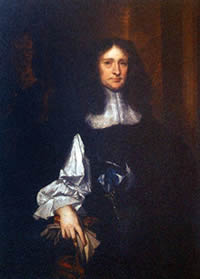
Sir George Carteret, as depicted here was a staunch supporter of both Charles I and Charles II. His unqualified loyalty to both father and son during the Civil War and his most generous hospitality towards the then young Prince Charles during his stay at Elizabeth Castle
found him awarded the roles of the Vice-Chamberlain to the King, Treasurer of the Navy and member of the Privy Council upon the Restoration of Charles II. Several wonderful websites offer excellent short biographies or stories related to Carteret including: 1911 Britannica; Wikipedia; Jersey Evening Post; and his Descendent Chart. Carteret’s famous years at Jersey, where he defended the Island in the name of Charles I, declared Charles II King, and ran a lucrative Privateering campaign are captured in the 1896 book by the Reverend Alban Ragg A Popular History of Jersey, chapters XII-XV. For those interested in more information on Island of Jersey during the years of Sir Philip Carteret, George’s Uncle and father of his wife, Elizabeth, a selection from the book Jean Chevalier and His TimesPrior to the Great Rebellion is available online. The site hosting this book extract is home to Le Cercle de Carteret who have extended an offer for ‘Family and Friends’ of the Carteret’s to take part in their upcoming activities, as updated on their site.
Prior to the Diary: The Jersey Years
The relationship between Carteret and the King is one of the rare “lifetime” relationships that Charles faithfully maintained. This relationship and extensive background on Carteret during his “Jersey years” is highlighted in this article. The following selection from that article, which is a quote from A.C. Saunders’ Jean Chevalier and His Times provides Saunders’ character sketch of Carteret, during his Jersey years:
There was not much sentiment about George Carteret. He knew what he wanted and was determined to get it. A great sailor and a faithful servant to the King and the Royal Cause, he realized that, when he became Lieutenant-Governor and had taken up duties in the Island, he would be in a very dangerous position, and that if he failed, the Parliamentarians would show him little mercy. He was a much stronger character than his uncle, the late Sir Philip [who had role prior to him], but had the same accumulative tendencies and was very fond of power and riches and, later on, was known in England as the rich Sir George. He was very brave and had very considerable organizing ability and he allowed few scruples to interfere with his plans for the good of the cause he had at heart, and he was determined to grant stern justice to those who, during the last year of his uncle’s life, had treated him so badly. The Parliamentarians had little encouragement to submit their grievances to his sense of justice. He would admit of no grievances and considered that for their past actions they deserved utmost penalties. Many fled from the Island, but during the next eight years those remaining could get little assistance or support from the English Parliament.
Sir George was all powerful in Jersey and, in all his actions, was supported by the members of the States who were always ready to follow his lead. Therefore he was always careful before taking any action in the Island to see that his conduct was in accordance with the legal procedure of the Island.
Therefore until 1651 he was the Dictator of the Island, and maintained the honour of the Royalist cause and, gathering together a number of ships and manning them with gallant mariners, he was able to spread terror among the English vessels trading to and from English ports, in the English Channel.
It is only a great man who could have done what he did in keeping the Royal Standard flying for nearly three years after the execution of Charles I, and historians in the past have done little justice to the gallant stand made by Sir George and his supporters in the little island of Jersey, a stand which required the greatest Admiral, Blake, with seventy ships and three thousand men to put down, and then only after Sir George had been granted full honours of war.
Notwithstanding his many faults and his lack of sympathy in his dealing with opponents, who were not faultless, he may be considered as one of the greatest leaders during the Civil Wars, and the Royalist stand in Jersey as one of the great epochs in history.
An argument between Carteret and Mr. Coventry causes Sam angst and starts a string of Diary entries about Coventry’s bad feelings towards Carteret. Two months later, Sam records with happiness that Carteret has put in a good word with the Lord Chancellor on his behalf.
The relationship between Sam and Carteret will grow both professionally and to some extent, personally. As the Diary proceeds, Sam will find himself involved in more of Carteret’s personal life and family matters, which he will splendidly record. He will also find himself witnessing the fall out the record keeping issues of the Dutch War, where Carteret will become the target of accusations. As a result of these accounting issues, Carteret will be censured by parliament and in 1667 will leave his role as Treasurer of the Navy and will become the deputy Treasurer of Ireland, and no longer involved with Sam in the remaining years of the Diary.
Further Resources
Biographies and related non-fiction about Sir George Carteret are listed below. Carteret kept a Journal during his trip to the Barbary Coast in 1638, which was printed in limited edition in 1929. Jean Chevalier, a Jersey man, kept a wonderful diary during the years that Sir George was Governor of the Island. The original is in French but the Saunders books draws heavily on the Chevalier Diary. These books may be available through your local library (with the help of the research department) or are sometimes available through the used book search. Some may be available on the US Amazon or UK Amazon.
All for the King by G.R. Balleine
Jean Chevalier and His Times by A. C. Saunders
Sir George Carteret, Lord Proprietor of New Jersey, With a Notice of the Isle of Jersey, And a Brief Sketch of Lord John Berkeley by William Nelson
The Barbary Voyage of 1638 by Sir George Carteret
Wikipedia
This text was copied from Wikipedia on 23 April 2024 at 4:10AM.
Carteret was the son of Elias de Carteret and Elizabeth Dumaresq of Jersey, who both died in 1640. Elias was the son of Philippe de Carteret I, 2nd Seigneur of Sark. With the help of his Uncle Philippe de Carteret II, 3rd Seigneur of Sark George was able to gain a position in the Royal Navy (George dropped the "de" from his surname when he entered the English navy, concerned that it sounded too French). George was "bred for the sea" and served as an officer in various naval ships, being commissioned as a Lieutenant of the Garland in 1629, and later in 1631, serving under Vice-Admiral Sir John Penington on the Bonaventure.
During this time the young Carteret and Admiral Penington would become friends. This friendship would serve Carteret well, as when Penington became the Admiral of the Narrow Seas in 1632, Carteret was given prominent positions throughout the 1630s where he would eventually be promoted to Captain in 1635 and command the Mary Rose and the Happy Entrance.[3] Carteret would join a small group of Naval Captains in presenting a memorial of the Navy to King Charles I, which according to Samuel Pepys, Carteret was responsible for presenting and recommending the first use of frigates in the Royal Navy, from blueprints of a Frenchman in Saint-Malo.[4]
In 1637, Carteret became involved in raids in the Pirate Republic of Salé in order to rescue Christian captives that were held there.[3] In 1641, Carteret was then a Vice-Admiral in command of the Rainbow. He was given the position of the Comptroller of the Navy in November 1641, for his service to King Charles II. [5]
As a result of his early life at sea, he received little or no formal education, and his embarrassing ignorance was a source of much ridicule in later life. Andrew Marvell mocked his poor command of English, and Samuel Pepys remarked that his ignorance of even the most basic Latin phrases would cause a schoolboy to be whipped. "Such ignorance is not to be borne in a Privy Councillor", wrote Pepys severely.
Sir George Carteret's Proclamation of King Charles II in Jersey 1649
Carteret quietly tried to carry on his duties at Comptroller of the Navy during the political fallout that had erupted between the supporters of Charles I and the supporters of Parliament. Many within the rank and file of the Royal Navy supported the Parliamentarian cause and the Robert Rich, 2nd Earl of Warwick, a keen parliamentarian, was made the High Lord Admiral of the Royal Navy in 1642 over Carteret's former commanding officer, John Penington, who was a royalist.
On the commencement of the Civil War, he retired from the Navy, and withdrew with his family to Jersey, where his uncle, Sir Philippe de Carteret, was the Bailiff and Lieutenant-Governor. The Island descended into conflict in 1643, with George and his uncle fighting on the side of the Royalists. The Royalists managed to hold onto the twin fortresses of Mont Orgueil and Elizabeth Castle and soon were able to rout the Island's Parliamentarian supporters. Carteret governed Jersey with great severity, imprisoning Parliamentarian supporters and confiscating their property.
Commissioned vice-admiral and knighted in 1645, Carteret conducted a successful privateering operation against Parliamentarian merchant ships. After the defeat of the Royalists on the mainland in 1645, Carteret afforded an asylum to the Prince of Wales (Charles Stuart) and other refugees of distinction within his government of Jersey, where he served as Bailiff (1643–1651).[5]
Carteret organised the Jersey Militia along parish lines, creating twelve distinct units each with 150 infantrymen under a captain, a lieutenant, as well as a few light guns. Each parish had a small troop of dragoons or mounted infantry. Carteret also had a small private army made up of Royalist veterans, who had fled from England after the defeat of Charles I, and a collection of foreign mercenaries. George Carteret also had Charles II proclaimed King in St. Helier on 17 February 1649 having 23 other prominent people of Jersey including his cousins Sir Philip Carteret and Elias Dumaresq sign the proclamation, after the execution of his father, Charles I.[6]
In 1651, a Parliamentarian expeditionary force was sent to capture the Islands. Colonel James Heane was appointed the military commander of the invasion force which numbered 3,000 men, comprising his own regiment, six companies of Sir Hardress Waller's foot, two troops of horse and 200 men from Guernsey. The naval commander was General-at-Sea Robert Blake, whose fleet included twelve warships and a further seventy supply ships and transports. The fleet was sighted at dawn on the 20 October to the north-east of Jersey and remained anchored in St. Ouen's Bay all day, waiting for favourable winds in order to start disembarking their troops on the shore.
Upon hearing this news, Sir George Carteret mobilized the Jersey Militia as well as his own professional soldiers. He dispatched the militia of Grouville to defend the town of St. Helier, the militia of St. Lawrence to defend the harbour at St. Aubin, and the militia of St. Brelade to defend the Bay of St. Brelade. Carteret took the bulk of the militia to St. Ouen's Bay, which they reached by noon on 20 October. In all, Carteret had about 2,000 men; 300 of which were cavalry, and the rest were infantry, and a score of cannon. With the bulk of the force being conscripts, however, it seems these men had little inclination for a pitched battle against the veterans of the New Model Army.
After several days of the Parliamentarian fleet trying to outmanoeuvre the Royalists (leading many militiamen to desert the Royalist cause), Admiral Blake decided to land his troops in the evening of the 22/23 October. Carteret noticed that some of the ships were heading for the shoreline and he gave the order for his army to prepare for battle. At first, the Royalist cavalry charge was able to thrown the Parliamentarians back into the sea, with the militiamen firing into the ranks of the fleeing invaders.
However, at the crucial moment, the cavalry commander, Colonel Bovill, was struck by a musket bullet and mortally wounded. With this loss, the cavalry fled from the battlefield and, with their retreat, the militiamen soon began to desert despite the efforts of Carteret to rally them. Colonel Heane's troops then got themselves organized and disembarked without incident.[7]
Colonel Heane soon began to overrun the Island, with no resistance being offered by the royalists. Carteret's sole plan was to hold onto the two castles of Mont Orgueil and Elizabeth Castle, as well as the fort on a small islet off St. Aubin's Bay, similar to the royalist strategy in 1643. This did not go according to plan, however, as the garrison of St. Aubin's Fort abandoned their posts to the oncoming parliamentarians on 23 October and Mont Orgueil, which was not suited to artillery warfare, surrendered on 25 October.
George Carteret, however, was determined to hold out at Elizabeth Castle, in the hopes that a royalist relief force from France would arrive, or in the hopes of frustrating the parliamentarians so much that they abandoned the siege.
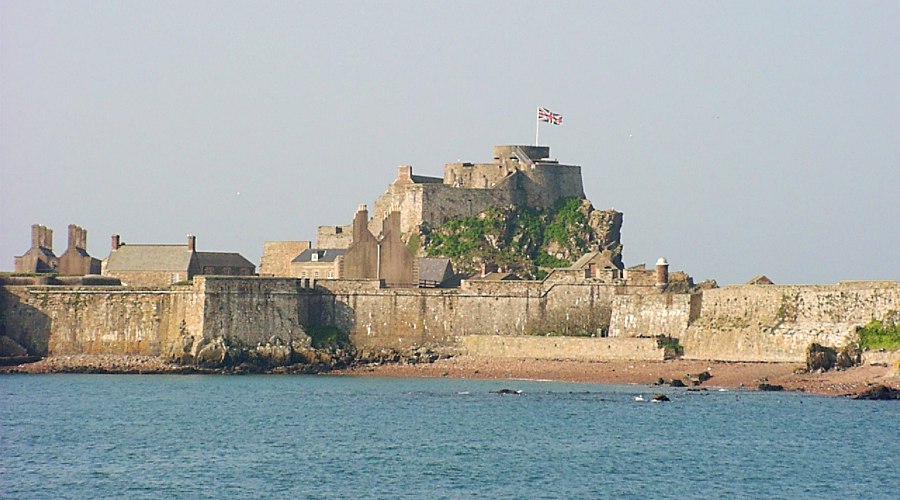
Elizabeth Castle was a far more imposing fortification than the likes of Mont Orgueil or St. Aubin's Fort. The castle was built on a rocky islet, which was about a mile off the coast, which meant that it was surrounded by the sea on all sides and made it difficult to be bombarded from the land. It also had an arsenal of fifty-three cannon defending the site, which had ample munitions, and enough provisions for the garrison for about eight months. Nevertheless, Colonel Heane erected a number of batteries as close to Elizabeth Castle as possible and began to bombard the castle. Also within Heane's arsenal were three large mortars which fired massive bombs, which were emplaced on a battery near the old harbour of St. Helier.
On the night of 9/10 November, a mortar shell fell onto the roof of the old Abbey Church, which just so happened to be the building where the defenders had been keeping their munitions and gunpowder. The shell exploded on the lowest storey of the priory and detonated the twelve barrels of gunpowder inside, which caused a massive explosion. The blast destroyed several adjacent buildings, which buried forty members of the garrison nearby the blast under rubble. Of these, sixteen men were killed and another ten were wounded.
The blast also destroyed two thirds of food stores and beer and cider rations. A panic ensued amongst the garrison in the aftermath of the explosion, with a number of the defenders deserting their posts and fleeing to St. Helier. These men were quickly captured and interrogated by the parliamentarians, who provided Colonel Heane with valuable information on the state of the castle's fortifications. The morale in the remaining garrison quickly declined, especially after an incident in which a Jerseyman of the garrison was hanged for desertion.
Despite these setbacks, George Carteret was determined to hold out for as long as possible, and he proceeded to keep the King's Standard flying over Elizabeth Castle for nearly another month. In that time, he received word from Charles II who had stated plainly that the French Government were unwilling to help, for fear of sparking a diplomatic incident with the English Commonwealth. Carteret was, therefore, very much on his own. Negotiations commenced between the two sides on 5 December and, by the 15 December, it was agreed the defending garrison was to march out of the castle with full honours, with officers permitted to retain their swords, breastplates, and pistols. Sir George Carteret was allowed to take a single vessel, sail with all his possessions to France, and formally join the household of the exiled Charles II. On the eve of the surrender, Sir George invited Colonel Heane to dinner and they met each other on the rocks at the foot of Fort Charles (Bastion a part of Elizabeth castle). On 15 December, Sir George sailed to St. Malo on his four gun sloop, 'Scout', accompanied by the parliamentarian warship, 'Eagle'.[7]
He stayed in exile in France for a six years until he was imprisoned in 1657, thence he ventured to Venice. The warmth and kindness with which he received the refugees earned him a permanent place in the King's affections, and also the friendship of Edward Hyde, 1st Earl of Clarendon, the King's chief adviser during his exile and for the first few years after the Restoration.
Spot of the Proclamation of King Charles II in Jersey 1649
His career for the next decade is documented in the diary of Samuel Pepys, who joined him as Clerk of the Acts to the Navy Board in 1660. In 1667, he exchanged his office as Vice-Chamberlain with Lord Anglesey for that of Vice-Treasurer of Ireland, an office which he sold in 1669 for £11,000.[5]
His influence seems to have been at its height in 1665, when he boasted to Pepys that the King did nothing without his knowledge; however, as the naval war dragged on, the Treasurer of the Navy was an obvious target of the opposition, and Pepys noted that by the spring of 1666 Carteret was being attacked on all sides. By the autumn of 1667, he confessed to Pepys that he was longing for the quiet of retirement. As Treasurer he was hard working and free from any suspicion of corruption, although his colleagues at the Navy Board complained that they found his accounts difficult to follow.
From 1661 to 1679, he represented Portsmouth, sponsored by the Admiralty, in the Cavalier Parliament. Although he sat on a number of committees he was a fairly inactive member of the house.[8]
American colonies
The fidelity with which Carteret, like John Berkeley, 1st Baron Berkeley of Stratton, had clung to the royal cause, gave him also great influence at court: he was close to Clarendon, and to the Earl of Sandwich, whose daughter married Carteret's eldest son. He had, at an early date, taken a warm interest in the colonization of America. In recognition of all the help given to him during his exile in Jersey in the 1640s, Charles II gave Carteret a large grant of land, part of the previously named New Netherland, which was promptly renamed New Jersey under his charge.[9] With Berkeley, he became one of the proprietors of the Province of Carolina prior to their becoming jointly interested in East Jersey. Carteret County, North Carolina and town of Carteret, New Jersey are named after him,[5] and the city of Elizabeth, New Jersey, is named after his wife,[10] as is Elizabethtown, North Carolina.[11]
In 1665, Carteret was one of the drafters of the Concession and Agreement, a document that provided freedom of religion in the colony of New Jersey. It was issued as a proclamation for the structure of the government for the colony written by the two proprietors, Lord Berkeley and Sir George Carteret.
Carteret was a signatory to The Several Declarations of The Company of Royal Adventurers of England Trading into Africa, a document published in 1667 which led to the expansion of the Royal Africa Company.[12][13][14]
Later life
In 1669, he faced expulsion from the House of Commons for misconduct as Vice Chamberlain, being accused of embezzlement.[15] After a statement from the king expressing his satisfaction with Carteret and an acquittal by the House of Lords, the inquiry against him lapsed. He was, in fact, generally regarded as an honest man.[16][14]
In 1673, he was appointed one of the Lords of the Admiralty, and continued in the public service until his death on 14 January 1680.
Shortly before Carteret's death, the king proposed to give him the title Baron Carteret, but Carteret died too soon, so the honour was granted to his grandson George.
Philip (1641–1672), their eldest son, married Lady Jemima Montagu, daughter of the Earl of Sandwich, and had four children: his eldest son George was raised to the peerage. Philip was killed in action at the Battle of Sole Bay, along with his father-in-law; Jemima had died in childbirth in November of the previous year.
James (died after 1679), served as a captain in the Royal Navy, and married and had children
Samuel Pepys liked and admired Lady Carteret "the most kind lady in the world."[18]
Controversy
George Carteret is seen as a divisive figure in Jersey, with some seeing him very much as swashbuckling local hero and others as a prolific slave trader who made his fortune through piracy and slavetrading.[19]
Jersey writer, Ollie Taylor, in his blog 'The whitewashing of George Carteret' says that on the one hand, 'Carteret has also been described as a hero, ‘Jersey’s greatest son’, one of “Jersey’s great figures” and a role model for youngsters.' But Taylor is also critical of a revisionist history saying, "By ignoring a fundamental part of Carteret’s story it ends up being exactly that, a rewriting of history'
He explains that, "He [Carteret] was one of the founding six committee members of the ‘Company of Royal Adventurers into Africa’, set up in 1660 to trade in gold, ivory and slaves. Which apparently was also a family affair with his son James ‘collecting’ over 300 slaves from Africa for transportation to the West Indies during one of the company’s early voyages in 1663. The company was succeeded nine years later and was the template for the ‘Royal African Company’, of whom Carteret was a consultant and early minor investor.
The Royal African Company went on to ship more African slaves to the Americas than any other institution in the history of the Atlantic slave trade. Between 1680 and 1688, it transported approximately 5,000 slaves a year totalling around 212,000 between 1662 and 1731. It’s estimated that 44,000 men, women and children died en route, with thousands of those who did survive arriving in the New World with the company’s initials branded on their chests."
In 2014, a Constable of Saint Peter sought and received over £36,000 in public funds to erect a statue of Carteret in Jersey, to commemorate the 350th anniversary of the founding of New Jersey.[20] In June 2020, following the murder of George Floyd and the widespread removal and destruction of monuments of those involved in slave trading around the world, the statue in Saint Peter was defaced with white paint due to Carteret's involvement with the Royal Africa Company.[21] One historian called the company "the single most prolific trader of slaves".[22] After calls from some residents of Jersey to move the statue to a museum were ignored,[23] it was defaced again in August 2020 with red paint and chains.[24][25]
^Jansso, Maija (10 September 2015). Art and Diplomacy: Seventeenth-Century English Decorated Royal Letters to Russia and the Far East. BRILL, 2015. p. 204. ISBN9789004300453.
^DePalma, Anthony. "If You're Thinking of Living in: Elizabeth", The New York Times, 28 August 1983. Retrieved 21 December 2011. "Elizabethtown, as it was originally called, missed the Elizabethan era by just 60 years and, in any event, the Elizabeth for whom it was named was not the queen but the wife of Sir George Carteret ..."
^Pettigrew, William Andrew. Freedom's debt : the Royal African Company and the politics of the Atlantic slave trade, 1672-1752. Omohundro Institute of Early American History & Culture. Chapel Hill [North Carolina]. ISBN978-1-4696-1183-9. OCLC879306121.
^Edward Scott for many years denied that he was the father of any of Catherine's children, on the ground that he and his wife had lived apart almost throughout their married life, but ultimately acknowledged Thomas as his son.
New Jersey Archives, First Series. Newark, NJ, 1880–1893, Volume 1, page 25.
Whitehead, William Adee, East Jersey under the proprietary governments. New York, New-Jersey historical society, 1846, page 104.
O'Callaghan, ed., Documents relating to the Colonial history of the State of New York, 1849–1851. Volume 2, page 410.
Marvell, Andrew, The poems and letters of Andrew Marvell; edited by H. M. Margoliouth. 3d ed. rev. by Pierre Legouis with the collaboration of E. E. Duncan-Jones. Oxford, Clarendon Press, 1971.
Sir George Carteret, born 1599, had originally been bred to the sea service, and became Comptroller of the Navy to Charles I., and Governor of Jersey, where he obtained considerable reputation by his gallant defence of that island against the Parliament forces. At the Restoration he was made Vice-Chamberlain to the King, Treasurer of the Navy, and a Privy Councillor, and in 1661 he was elected M.P. for Portsmouth. In 1666 he exchanged the Treasurership of the Navy with the Earl of Anglesea for the Vice-Treasurership of Ireland. He became a Commissioner of the Admiralty in 1673. He continued in favour with Charles II. till his death, January 14th, 1679, in his eightieth year. He married his cousin Elizabeth, daughter of Sir Philip Carteret, Knight of St. Ouen, and had issue three sons and five daughters.
This text comes from a footnote on a diary entry in the 1893 edition edited by Henry B. Wheatley.
More : George Carteret of Saltrum Lots of discrepancies (need an army of Lawyers to decypher the original documents ) of c(o)urse there is money and family involved one says 1599 year of birth others say 1610 Carteret, Sir George , c. 1610–1680, proprietor of East Jersey (see New Jersey ). He served in the British navy, fought for the royalists, and became (1643) lieutenant governor of his native island of Jersey. In 1663, with several others, he was granted the proprietorship of Carolina and in 1664, in conjunction with Lord Berkeley, was granted part of New Jersey. His widow sold his claim to 12 purchasers who joined with 12 others as the 24 proprietors of East New Jersey.
There is a borough of Carteret in New Jersey (across the Arthur Kill from Staten Island).
There was also a Carteret County in South Carolina (another colony George Carteret was involved with) but after being founded in 1685, it changed its name to Granville in 1708. http://archiver.rootsweb.com/th/r…
But there's a Carteret County on the coast of North Carolina.
The house of C. doth have Sir Geo. up in front of their committee, but there be no 'CNN' to tells us of his Grilling. Leidger book of Sir George Carteret,1664 For those that want have vision of hind sight nov/ dec: 1669: see:
When Carteret was Governor of East Jersey he was involved with trying to prevent Edmund Andros from invading and annexing NJ from NY. He failed and Andros ran the place until James II was deposed.
From the July 17, 1663 entry. I just started reading Carteret’s biography, but am not far enough along to get a full picture of him. What is clear is that he did NOT like school,or his early teacher (Pipon), but loved the sea. Balleine in “All for the King”, says “George hated the school. He hated Pierre Pipon, the Regent. The syntax problems of the ancient Romans roused in him no spark of curiosity. In later life his ignorance of the classics shocked some of his colleagues. Once, when he saw hangings in the Duke of York’s chamber depicting a scene in Rome, he asked Pepys what the S.P.Q.R. on the standards stood for, “ignorance”, scoffed the Diarist, “not to be borne in a Privy Councillor; methinks a schoolboy would be whipped for not knowing”. Yet George’s schooltime was not wasted. Scores of his letters survive, which show that he could express himself in good grammatical English, remarkably good when one remembers that French was his native tongue. His spelling was better than that of many of the other courtiers, and the detailed Reports that he wrote of his two expeditions are admirably lucid and graphic. Moreover the intricate financial transactions that he had to control later, first as Treasurer of the Navy, and then as Vice-Treasurer of Ireland show that he must have been no mean arithmetician. Pierre Pipon had not wielded the birch in vain.” (p. 5) George also left school at an early age to go to sea (around age 13 or younger). Lady Fanshaw (who knew him well) says in her Memoirs that he was “bred as a sea-boy”. (p. 5)
Another interesting point is that “no scandal marred his record”, so the libertine court of Charles II and the loose morals of the time did not seem to be a pull to him as there are no mentions of mistresses and his love letters to his wife during their courtship have a nice sincerity to them. Finally, in a general context, Balleine says” Carteret was no dashing hero of romance like Montrose or Rupert, though, as many of his exploits show, as a fighting man he was utterly fearless: but we see him mainly as a sober, hard-working servant of the King whose Royalism was his religion. A simple, undeviating, almost doglike devotion to the Crown was the mainspring of all of his actions. He had his faults, including one bad one [which isn’t mentioned here],which we have tried not to disguise;but he remains an outstanding example of the Cavalier ideal of utter and unswerving loyalty, an ideal which his family enshrined in their motto ‘Loyal devoir’”. (p 2)
Sir George Carteret had originally been bred to the sea service, and became Comptroller of the Navy to Charles I., and Governor of Jersey, where he obtained considerable reputation by his gallant defence of that Island against the Parliament forces. At the Restoration, be was made Vice-Chamberlain to the King, Treasurer of the Navy, and a Privy Councillor, and in 1661 was elected M.P. for Portsmouth. He continued in favour with his sovereign till his death, in 1679, aet. suae 80. He married his cousin Elizabeth, daughter of Sir Philip Carteret, of St. Ouen, and had issue three sons and five daughters. ---Diary and correspondence of Samuel Pepys, the diary deciphered by J. Smith. 1854.
CARTERET, Sir GEORGE (d. 1680), governor of Jersey; of an old Jersey family; lieutenant in the navy, 1632; captain, 1633; second in command against the Sallee pirates, 1637: controller of the navy, 1639; offered a command by parliament, 1642; from St. Malo, Brittany, sent supplies and arms to the royalists in the west and in the Channel islands; sent by Charles I to Jersey, 1643; reduced the island; sent out privateers against English ships; gave a refuge to royalists, 1646; created baronet, 1646; granted estates in Jersey and America, 1649; surrendered to the Commonwealth forces, December 1651; vice-admiral in the French navy; imprisoned, August 1657; banished from France, December 1657; withdrew to Venice; treasurer of the navy, 1660-7; vice-chamberlain of the household, 1660-70; M.P., Portsmouth, 1661-9; a proprietor of Carolina, 1663; deputy-treasurer of Ireland, 1667-73; board of trade commissioner. 1668-72; naval commissioner, 1673-9. ---Dictionary of National Biography: Index and Epitome. S. Lee, 1906.
CARTERET, Sir George, 1st Bt. (c.1610-80), of Whitehall and Hawnes, Beds. Published in The History of Parliament: the House of Commons 1660-1690, ed. B.D. Henning, 1983
Sir George Carteret, Baronet, a Frenchman, vice-chamberlain to the once treasurer of Ireland, and the navy, in which two places he cheated the crown of 400000l. as upon account was made apparent. He has wisely conveyed great part of his estate beyond sea, therefore deservedly made a privy counsellor. ---A Seasonable Argument. Andrew Marvell, 1677.
"... by and by came Sir G. Carteret and we all looked into matters, and then by water back to Deptford, where we dined with him at his house, ..." http://www.pepysdiary.com/diary/1…
From Carteret's Parliamentary biography: at the Restoration:
"In 1649 Charles wrote to Carteret, promising never to forget his good services, and he appears to have kept his word. He ‘had the honour to hold the last sword for the King’; it was not until December 1651 that the Commonwealth forces were able to subdue Jersey, and then only by granting Carteret generous terms. He was not required to compound for his privateering gains, and took service in the French navy until Mazarin’s alliance with Cromwell, when he was briefly sent to the Bastille.
"After the death of the Protector he resumed contact with the exiled Court, signing his letters, mischievously, with the name of the author of Eikonoklastes.
"Carteret had not been impoverished by his loyalty. At his own computation he was worth £50,000 at the Restoration, including his claims for reimbursement, for which provision was at once made by means of crown leases in Devon and elsewhere. Together with Daniel O’Neill he farmed the duty on French shipping at an annual rent of £1,000. He was made vice-chamberlain, treasurer of the navy, and a Privy Councillor.
"In his administrative capacities his loyalty, industry and integrity were beyond cavil, even his adversary William Coventry said ‘he is a man that doth take the most pains, and gives himself the most to do business of any man about the Court, without any desire of pleasure or divertisements’.
"Essentially a family man, he was disgusted by ‘the baseness and looseness of the Court’ to the point of reminding his former guest of ‘the necessity of having at least a show of religion in the government, and sobriety’.
"Lord Chancellor Clarendon declared Carteret was ‘a punctual officer and a good accountant’; but Pepys found his ignorance in financial matters perverse and ridiculous, complaining that he argued ‘like a mad coxcomb, without reason or method’. ‘ ... it was always his humour to have things done his way’, and his accounts were so idiosyncratic that no audit was possible. On such occasions he took care to provide the navy board with an excellent dinner to lubricate proceedings.
"At the election of 1661 Carteret was returned for Portsmouth on the Admiralty interest. An inactive Member of the Cavalier Parliament, ... during the administration of Clarendon, whose great confidant he was."
L&M: The Treasurer (the best paid of the Principal Officers of the Navy) received a fixed stipend of £2,000 p.a. in 1660-2. After 1663 it was by the more lucrative method of fees, allowances and poundage. After 1668 a salary was paid.
Carteret, … had official lodgings at Whitehall, a house in Pall Mall, an official residence at Deptford and a country mansion near Windsor, ... http://www.pepysdiary.com/encyclo…


.png)


14 Annotations
First Reading
vincent • Link
More : George Carteret of Saltrum
Lots of discrepancies (need an army of Lawyers to decypher the original documents )
of c(o)urse there is money and family involved
one says 1599 year of birth others say 1610
Carteret, Sir George , c. 1610–1680, proprietor of East Jersey (see New Jersey ). He served in the British navy, fought for the royalists, and became (1643) lieutenant governor of his native island of Jersey. In 1663, with several others, he was granted the proprietorship of Carolina and in 1664, in conjunction with Lord Berkeley, was granted part of New Jersey. His widow sold his claim to 12 purchasers who joined with 12 others as the 24 proprietors of East New Jersey.
http://www.nj.gov/njfacts/njdoc6.…
http://12.1911encyclopedia.org/C/…
http://www.infoplease.com/ce6/peo…
vincent • Link
Sir Geo: Carteret Bart. was Married to Lady Elizabeth(ref J.Evelyn)
Pauline • Link
From: A Hamilton on Sun 13 Jun 2004, 1:08 am | Link
David Quidnunc • Link
Place names
There is a borough of Carteret in New Jersey (across the Arthur Kill from Staten Island).
There was also a Carteret County in South Carolina (another colony George Carteret was involved with) but after being founded in 1685, it changed its name to Granville in 1708.
http://archiver.rootsweb.com/th/r…
But there's a Carteret County on the coast of North Carolina.
Cumgranissalis • Link
The house of C. doth have Sir Geo. up in front of their committee, but there be no 'CNN' to tells us of his Grilling.
Leidger book of Sir George Carteret,1664
For those that want have vision of hind sight nov/ dec: 1669: see:
http://www.british-history.ac.uk/…
http://www.british-history.ac.uk/…
Q • Link
When Carteret was Governor of East Jersey he was involved with trying to prevent Edmund Andros from invading and annexing NJ from NY. He failed and Andros ran the place until James II was deposed.
jeannine • Link
From the July 17, 1663 entry.
I just started reading Carteret’s biography, but am not far enough along to get a full picture of him. What is clear is that he did NOT like school,or his early teacher (Pipon), but loved the sea. Balleine in “All for the King”, says “George hated the school. He hated Pierre Pipon, the Regent. The syntax problems of the ancient Romans roused in him no spark of curiosity. In later life his ignorance of the classics shocked some of his colleagues. Once, when he saw hangings in the Duke of York’s chamber depicting a scene in Rome, he asked Pepys what the S.P.Q.R. on the standards stood for, “ignorance”, scoffed the Diarist, “not to be borne in a Privy Councillor; methinks a schoolboy would be whipped for not knowing”. Yet George’s schooltime was not wasted. Scores of his letters survive, which show that he could express himself in good grammatical English, remarkably good when one remembers that French was his native tongue. His spelling was better than that of many of the other courtiers, and the detailed Reports that he wrote of his two expeditions are admirably lucid and graphic. Moreover the intricate financial transactions that he had to control later, first as Treasurer of the Navy, and then as Vice-Treasurer of Ireland show that he must have been no mean arithmetician. Pierre Pipon had not wielded the birch in vain.” (p. 5)
George also left school at an early age to go to sea (around age 13 or younger). Lady Fanshaw (who knew him well) says in her Memoirs that he was “bred as a sea-boy”. (p. 5)
Another interesting point is that “no scandal marred his record”, so the libertine court of Charles II and the loose morals of the time did not seem to be a pull to him as there are no mentions of mistresses and his love letters to his wife during their courtship have a nice sincerity to them.
Finally, in a general context, Balleine says” Carteret was no dashing hero of romance like Montrose or Rupert, though, as many of his exploits show, as a fighting man he was utterly fearless: but we see him mainly as a sober, hard-working servant of the King whose Royalism was his religion. A simple, undeviating, almost doglike devotion to the Crown was the mainspring of all of his actions. He had his faults, including one bad one [which isn’t mentioned here],which we have tried not to disguise;but he remains an outstanding example of the Cavalier ideal of utter and unswerving loyalty, an ideal which his family enshrined in their motto ‘Loyal devoir’”. (p 2)
Aqua • Link
xref
Sir G Carteret 1660 2 June Vice Chamberline 1660
http://www.british-history.ac.uk/…
Second Reading
Bill • Link
Sir George Carteret had originally been bred to the sea service, and became Comptroller of the Navy to Charles I., and Governor of Jersey, where he obtained considerable reputation by his gallant defence of that Island against the Parliament forces. At the Restoration, be was made Vice-Chamberlain to the King, Treasurer of the Navy, and a Privy Councillor, and in 1661 was elected M.P. for Portsmouth. He continued in favour with his sovereign till his death, in 1679, aet. suae 80. He married his cousin Elizabeth, daughter of Sir Philip Carteret, of St. Ouen, and had issue three sons and five daughters.
---Diary and correspondence of Samuel Pepys, the diary deciphered by J. Smith. 1854.
Bill • Link
CARTERET, Sir GEORGE (d. 1680), governor of Jersey; of an old Jersey family; lieutenant in the navy, 1632; captain, 1633; second in command against the Sallee pirates, 1637: controller of the navy, 1639; offered a command by parliament, 1642; from St. Malo, Brittany, sent supplies and arms to the royalists in the west and in the Channel islands; sent by Charles I to Jersey, 1643; reduced the island; sent out privateers against English ships; gave a refuge to royalists, 1646; created baronet, 1646; granted estates in Jersey and America, 1649; surrendered to the Commonwealth forces, December 1651; vice-admiral in the French navy; imprisoned, August 1657; banished from France, December 1657; withdrew to Venice; treasurer of the navy, 1660-7; vice-chamberlain of the household, 1660-70; M.P., Portsmouth, 1661-9; a proprietor of Carolina, 1663; deputy-treasurer of Ireland, 1667-73; board of trade commissioner. 1668-72; naval commissioner, 1673-9.
---Dictionary of National Biography: Index and Epitome. S. Lee, 1906.
Terry Foreman • Link
CARTERET, Sir George, 1st Bt. (c.1610-80), of Whitehall and Hawnes, Beds.
Published in The History of Parliament: the House of Commons 1660-1690, ed. B.D. Henning, 1983
http://www.historyofparliamentonl…
Bill • Link
Sir George Carteret, Baronet, a Frenchman, vice-chamberlain to the once treasurer of Ireland, and the navy, in which two places he cheated the crown of 400000l. as upon account was made apparent. He has wisely conveyed great part of his estate beyond sea, therefore deservedly made a privy counsellor.
---A Seasonable Argument. Andrew Marvell, 1677.
San Diego Sarah • Link
"... by and by came Sir G. Carteret and we all looked into matters, and then by water back to Deptford, where we dined with him at his house, ..." http://www.pepysdiary.com/diary/1…
Third Reading
San Diego Sarah • Link
From Carteret's Parliamentary biography: at the Restoration:
"In 1649 Charles wrote to Carteret, promising never to forget his good services, and he appears to have kept his word. He ‘had the honour to hold the last sword for the King’; it was not until December 1651 that the Commonwealth forces were able to subdue Jersey, and then only by granting Carteret generous terms. He was not required to compound for his privateering gains, and took service in the French navy until Mazarin’s alliance with Cromwell, when he was briefly sent to the Bastille.
"After the death of the Protector he resumed contact with the exiled Court, signing his letters, mischievously, with the name of the author of Eikonoklastes.
"Carteret had not been impoverished by his loyalty. At his own computation he was worth £50,000 at the Restoration, including his claims for reimbursement, for which provision was at once made by means of crown leases in Devon and elsewhere. Together with Daniel O’Neill he farmed the duty on French shipping at an annual rent of £1,000. He was made vice-chamberlain, treasurer of the navy, and a Privy Councillor.
"In his administrative capacities his loyalty, industry and integrity were beyond cavil, even his adversary William Coventry said ‘he is a man that doth take the most pains, and gives himself the most to do business of any man about the Court, without any desire of pleasure or divertisements’.
"Essentially a family man, he was disgusted by ‘the baseness and looseness of the Court’ to the point of reminding his former guest of ‘the necessity of having at least a show of religion in the government, and sobriety’.
"Lord Chancellor Clarendon declared Carteret was ‘a punctual officer and a good accountant’; but Pepys found his ignorance in financial matters perverse and ridiculous, complaining that he argued ‘like a mad coxcomb, without reason or method’. ‘ ... it was always his humour to have things done his way’, and his accounts were so idiosyncratic that no audit was possible. On such occasions he took care to provide the navy board with an excellent dinner to lubricate proceedings.
"At the election of 1661 Carteret was returned for Portsmouth on the Admiralty interest. An inactive Member of the Cavalier Parliament, ... during the administration of Clarendon, whose great confidant he was."
NOTE: Carteret's bio also says he does not become Treasurer of the Navy until July, 1660.
http://www.historyofparliamentonl…
L&M: The Treasurer (the best paid of the Principal Officers of the Navy) received a fixed stipend of £2,000 p.a. in 1660-2. After 1663 it was by the more lucrative method of fees, allowances and poundage. After 1668 a salary was paid.
Carteret, … had official lodgings at Whitehall, a house in Pall Mall, an official residence at Deptford and a country mansion near Windsor, ... http://www.pepysdiary.com/encyclo…