Thomas Fuller (baptised 19 June 1608 – 16 August 1661) was an English churchman and historian. He is now remembered for his writings, particularly his Worthies of England, published in 1662, after his death. He was a prolific author, and one of the first English writers able to live by his pen (and his many patrons).[1][2]
Fuller's oratory soon attracted attention. In June 1631 his uncle gave him a prebend in Salisbury, where his father, who would die in the following year, already held a canonry. The rectory of Broadwindsor, Dorset, then in the diocese of Bristol, was his next preferment (1634); and on 11 June 1635 he achieved the degree of Bachelor of Divinity from Sidney Sussex College, Cambridge.[3] In 1640, he was elected proctor for Bristol in the memorable Convocation of Canterbury, which assembled with the Short Parliament. On the sudden dissolution of the latter he joined those who urged that convocation should likewise dissolve. That opinion was overruled; and the assembly continued to sit by royal writ. Fuller wrote a valuable account of the proceedings of this synod in his Church History, although he was fined £200 for remaining.
Civil War period
At Broadwindsor, early in 1641, Thomas Fuller, his curate Henry Sanders, the churchwardens, and five others certified that their parish, represented by 242 adult males, had taken the Protestation ordered by the speaker of the Long Parliament. Fuller was not formally dispossessed of his living and prebend on the triumph of the Presbyterian party, but he relinquished both preferments about this time. For a short time he preached with success at the Inns of Court, and then at the invitation of the master of the Savoy, Walter Balcanqual, and the brotherhood of that foundation, became lecturer at their chapel of St Mary Savoy. Some of the best discourses of the witty preacher were delivered at the Savoy to audiences which extended into the chapel-yard. In one he set forth with searching and truthful minuteness the hindrances to peace, and urged the signing of petitions to the king at Oxford, and to the parliament, to continue their care in advancing an accommodation.
In his Appeal of Injured Innocence Fuller says that he was once deputed to carry a petition to the king at Oxford. This has been identified with a petition entrusted to Sir Edward Wardour, clerk of the pells, Dr Dukeson, "Dr Fuller," and four or five others from the city of Westminster and the parishes contiguous to the Savoy. A pass was granted by the House of Lords, on 2 January 1643, for an equipage of two coaches, four or six horses and eight or ten attendants. On the arrival of the deputation at the Treaty of Uxbridge, on 4 January, officers of the Parliamentary army stopped the coaches and searched the gentlemen; and they found upon the latter "two scandalous books arraigning the proceedings of the House," and letters with ciphers to Lord Viscount Falkland and the Lord Spencer. A joint order of both Houses remanded the party; and Fuller and his friends were briefly imprisoned. The Westminster Petition reached the king's hands; and it was published with the royal reply.[4]
When it was expected, three months later, that a favourable result would attend the negotiations at Oxford, Fuller preached a sermon at Westminster Abbey, on 27 March 1643, on the anniversary of Charles I's accession, on the text, "Yea, let him take all, so my Lord the King return in peace." On Wednesday 26 July, he preached on church reformation, satirising the religious reformers, and maintaining that only the Supreme Power could initiate reforms.
He was now obliged to leave London, and in August 1643 he joined the king at Oxford, where he lodged in a chamber at Lincoln College. Thence he put forth a witty and effective reply to John Saltmarsh, who had attacked his views on ecclesiastical reform. Fuller subsequently published by royal request a sermon preached on 10 May 1644, at St Mary's, Oxford, before the king and Prince Charles, called Jacob's Vow. The spirit of Fuller's preaching, characterised by calmness and moderation, offended the high royalists. To silence unjust censures he became chaplain to the regiment of Sir Ralph Hopton.
For the first five years of the war, he "had little list or leisure to write, fearing to be made a history, and shifting daily for my safety. All that time I could not live to study, who did only study to live." After the defeat of Hopton at Cheriton Down, Fuller retreated to Basing House. He took an active part in its defence, and his life with the troops caused him to be afterwards regarded as one of "the great cavalier parsons". He compiled in 1645 a small volume of prayers and meditations – the Good Thoughts in Bad Times – which, set up and printed in the besieged city of Exeter, where he had retired, was called by himself "the first fruits of Exeter press". It was inscribed to Lady Dalkeith, governess to the infant princess, Henrietta Anne (b. 1644), to whose household he was attached as chaplain. The corporation gave him the Bodleian lectureship on 21 March 1646, and he held it until 17 June following, soon after the surrender of the city to the parliament.
The Fear of Losing the Old Light (1646) was his farewell discourse to his Exeter friends. Under the Articles of Surrender Fuller made his composition with the government at London, his "delinquency" being that he had been present in the king's garrisons. In Andronicus, or the Unfortunate Politician (1646), partly authentic and partly fictitious, he satirised the leaders of the Revolution; and for the comfort of sufferers by the war he issued (1647) a second devotional manual, entitled Good Thoughts in Worse Times, abounding in fervent aspirations, and drawing moral lessons in beautiful language out of the events of his life or the circumstances of the time. In grief over his losses, which included his library and manuscripts (his "upper and nether millstone"), and over the calamities of the country, he wrote his work on the Cause and Cure of a Wounded Conscience (1647). It was prepared at Boughton House in his native county, where he and his son were entertained by Edward Lord Montagu, who had been one of his contemporaries at the university and had taken the side of the parliament. For the next few years of his life Fuller was mainly dependent upon his dealings with booksellers, of whom he asserted that none had ever lost by him. He made considerable progress in an English translation from the manuscript of the Annales of his friend Archbishop Ussher.
Under the Commonwealth
Amongst his benefactors was Sir John Danvers of Chelsea, the regicide. Fuller in 1647 began to preach at St Clement's, Eastcheap, and elsewhere in the capacity of lecturer. While at St Clement's he was suspended; but soon recovered his freedom and preached wherever he was invited. At Chelsea, where he also occasionally officiated, he covertly preached a sermon on the death of Charles, but he did not break with his Roundhead patrons. James Hay, 2nd Earl of Carlisle made him his chaplain, and presented him in 1648 or 1649 to the curacy of Waltham Abbey. His possession of the living was in jeopardy on the appointment of Oliver Cromwell's "Tryers"; but he evaded their inquisitorial questions by his ready wit. He was not disturbed at Waltham in 1655, when the Protector's edict prohibited the adherents of the late king from preaching.
There is good reason to suppose that Fuller was at the Hague immediately before the Restoration, in the retinue of Lord Berkeley, one of the commissioners of the House of Lords, whose last service to his friend was to interest himself in obtaining him a bishopric. A Panegyrick to His Majesty on his Happy Return, one of the many contemporary poems celebrating the restoration of Charles II, was the last of Fuller's verse efforts.
After the Restoration
On 2 August 1660, by royal letters, he was admitted Doctor of Divinity at Cambridge. He resumed his lectures at the Savoy, where Samuel Pepys heard him preach; but he preferred his conversation or his books to his sermons. Fuller's last promotion was that of Chaplain Extraordinary to Charles II.
Death
St Dunstan's Church, Cranford Park, where Fuller was buried.
In the summer of 1661 Fuller visited the West in connection with the business of his prebend, which had been restored to him. On Sunday 12 August, while preaching at the Savoy, he was seized with typhus fever, and died at his new lodgings in Covent Garden on 16 August. He was buried in St Dunstan's Church, Cranford, Middlesex (of which he was rector). A mural tablet was afterwards set up on the north side of the chancel, with an epitaph which contains a conceit worthy of his own pen, to the effect that while he was endeavouring (i.e. in the Worthies) to give immortality to others, he himself attained it.
Works
David's Heinous Sinne, Heartie Repentance, Heavie Punishment (1631). Fuller published a poem on the subject of David and Bathsheba.
The Historie of the Holy Warre (1639).[5] A history of the Crusades from the fall of Jerusalem under Titus in 70 AD through 1290. Includes critical commentary, a complete chronology, and bibliography. With an introduction by English classical scholar James Duport (1606–1679). The History of the Holy War[6] is an 1840 edition of the work.
Joseph's party-coloured Coat (1640). His first published volume of sermonsEngraved title page of the third edition of Historie of the Holy Warre by Thomas Fuller, 1647.
The Holy State and the Prophane State (1642). This work describes the holy state as existing in the family and in public life, gives rules of conduct, model "characters" for the various professions and profane biographies. It was perhaps the most popular of all his writings.
A Pisgah-Sight of Palestine and the confines thereof; with the history of the Old and New Testaments acted thereon (1650).[7] With facsimiles of all the quaint maps and illustrations of the original edition. Lionel Cranfield, 3rd Earl of Middlesex, who lived at Copt Hall, near Waltham, gave him what remained of the books of the lord treasurer his father; and through the good offices of the marchioness of Hertford, part of his own pillaged library was restored to him. Fuller was thus able to prosecute his literary labours, producing successively his descriptive geography of the Holy Land.
Abel Redevivus: or The dead yet speaking. The lives and the deaths of the moderne divines. Written by severall able and learned men (whose names ye shall finde in the epistle to the reader.) And now digested into one volumne, for the benefit and satisfaction of all those that desire to be acquainted with the paths of piety and virtue. (1651). London, John Stafford.
Church-History of Britain, from the birth of Jesus Christ until the year 1648 (1655). Church-History was printed with The History of the University of Cambridge since the Conquest and The History of Waltham Abbey. These works were furthered by his connection with Sion College, London, where he had a room. The Church History was angrily attacked from the high-church side by Peter Heylin. At the Oxford Act of 1657, Robert South, who was Terrae filius, lampooned Fuller, whom he described in this Oratio as living in London, ever scribbling and each year bringing forth new folia like a tree. At length, continues South, the Church-History came forth with its 166 dedications to wealthy and noble friends; and with this huge volume under one arm, and his wife (said to be little of stature) on the other, he ran up and down the streets of London, seeking at the houses of his patrons invitations to dinner, to be repaid by his dull jests at table. His last and best patron was George Berkeley, 1st Earl Berkeley (1628–1698), of Cranford House, Middlesex, whose chaplain he was, and who gave him Cranford rectory (1658). Fuller afterwards dedicated The Appeal of Injured Innocence (1659), his reply to Heylyn's Examen Historicum, to Berkeley. In An Alarum to the Counties of England and Wales (1660) Fuller argued for a free and full parliament—free from force, as he expressed it, as well as from abjurations or previous engagements. Mixt Contemplations in Better Times (1660), dedicated to Lady Monk, tendered advice in the spirit of its motto, "Let your moderation be known to all men: the Lord is at hand".
'Notes upon Jonah', (1657). John Stafford.
History of the Worthies of England (1662).[8] Fuller's best-known work.
The Poems and translations in verse, including fifty-nine hitherto unpublished epigrams of Fuller and his much-wished form of prayer for the first time collected and edited with introduction and notes, by rev. Grosart, 257 pp., Liverpool, printed for private circulation (1868).
A Pisgah-Sight of Palestine – Gallery
Icon Tabernaculi
Atria Templi Solominis
Terra Moriath
Terra Canaan
Pisgah-sight of Palestine
Tribe of Asher
Tribe of Benjamin
Tribe of Dan
Tribe of Ephraim
Tribe of Gad
Tribe of Issacar
Tribe of Judah
Tribe of Manasse
Tribe of Naphtali
Tribe of Reuben
Tribe of Simeon
Tribe of Zebulon
Terra Canaan and Tribes
Reception
Fuller's sense of humour kept him from extremes. "By his particular temper and management", said Laurence Echard in his History of England, "he weathered the late great storm with more success than many other great men". He was known as "a perfect walking library". Antithetic and axiomatic sentences abound in his pages. "Wit," wrote Coleridge after reading the Church History, "was the stuff and substance of Fuller's intellect".[9]Charles Lamb made some selections from Fuller, and admired his "golden works." American essayist Samuel McChord Crothers devoted a chapter of his 1916 book The Pleasures of an Absentee Landlord to an appreciation of Fuller and of the genial spirit of Fuller's prose, writing that
Fuller retains the intimate tone of one who is in a little circle of friends. There is no attempt at the impartial dignity of history. If he tells what happens, he takes it for granted that we should like to know what he thinks about it.[10]
Family
In about 1640 Fuller married Eleanor, daughter of Hugh Grove of Chisenbury, Wiltshire. She died in 1641. Their son, John, baptised at Broadwindsor by his father on 6 June 1641, was afterwards of Sidney Sussex College, Cambridge, saw his father's Worthies of England through the press in 1662, and became rector of Great Wakering, Essex, where he died in 1687.
Bailey, J. E. (1874) The Life of Thomas Fuller, with Notices of his Books, his Kinsmen and his Friends. 800 p. London: B. M. Pickering (with a detailed bibliography (pp. 713–762) of his works)
Fuller, Thomas (1840) The History of the University of Cambridge: from the Conquest to the year 1634. Cambridge University Press (reissued by Cambridge University Press, 2009; ISBN978-1-108-00465-7)
Fuller, Thomas (1811) The Worthies of England, reprinted by John Nichols (1811) and by P. A. Nuttall (1840) Vol.1Vol.2Vol.3 at books.google.
Fuller, Thomas (1891) Collected Sermons; edited by J. E. Bailey; completed by W. E. A. Axon. 2 vols. London: Unwin Bros
Thomae Fulleri Pharmacopoeia extemporanea oder die sichere, vollständige und auserlesene Apotheke : worinnen mehr als tausend Hülfsmittel zu finden, die bey allen dem Menschen zustossenden Krankheiten, sicher und mit Nutzen gebraucht werden können ; zum allgemeinen Besten derer, so auf dem Land und entfernten Orten wohnen. Basel : Im Hof, 1750. Digital edition by the University and State Library Düsseldorf
"the great Tom Fuller" Now (according to the Companion) "best remembered for his history of English families, The history of the worthies of England (first pub. 1662)." He was a royalist and a popular preacher; Pepys "was especially fond of reading (on Sundays) his Church-history of Britain (1655)."
More (much more) can be found in the (lamentably badly scanned) 1911 Britannica entry here: http://90.1911encyclopedia.org/F/… (scroll down); fans of James Joyce will especially appreciate the mention of his A Pisgah-Sight of Palestine (1650).
Here is the entry on him from The Cambridge History of English and American Literature in 18 Volumes (1907
Your friend is the man who knows all about you, and still likes you." -- Dr. Thomas Fuller (1608-61), English clergyman, writer, "The Church History of Britain source of interesting quotes --------------------------------
FULLER, THOMAS (1608-1661), English divine and historian, eldest son of Thomas Fuller, rector a lenthy dissertatation: http://www.bartleby.com/81/18088.…
He was born within the sound of Bow-bell. - Gnomologia
I note this quotation from Fuller on one of the links above - does anybody know whether he was the originator of this saying, or whether he was merely repeating a maxim that was commonplace by then?
I'm sorry, but this quote is from the hand of another Thomas Fuller: "Gnomologia, Adagies and Proverbs, Wise Sentences and Witty Sayings, Ancient and Modern, Foreign and British", 1732 by Dr Thomas Fuller MD(Editor) (1654-1734).
"Our" Thomas Fuller (1608-1661), clergyman, divine and historian, wrote his works somewhat earlier. His text on "The Cause and Cure of a Wounded Conscience" from 1647 can be read on: http://justus.anglican.org/resour…
Thomas Fuller is not an uncommon name.
The **Bow-bell** is referred to in many places, i.a.: Sir Walter Scott's "The Fortunes Of Nigel": "It is a credit to her, that, bred and born within the sound of Bow-bell, she can blush for any thing." http://arthurwendover.com/arthurs… and: "Gratiae Ludentes; or, Jestes from the University." by H.L. Oxon, London, 1638: "A Scholler being about to describe one that spake very bigge, said he spake as if he had a Bow-bell in his mouth." http://www.ucs.mun.ca/~wbarker/gr…
There must have been many expressions with "Bow-bell" around before the 1732 Gnomologia...
I mistakenly thought that Bow Bells must have been in the district of Bow in east London, but in fact the church is St Mary le Bow, which is in the heart of the City.
"Originally called St. Mary New Church (St. Mary Aldermary in Bow Lane was the 'Older' Church), by the Norman period this Church was called Sancta Maria de Arcubus. Arcubus refers to the arch or bow arches which were in the crypt, commemorated in the bows on top of the medieval tower.
When Wren rebuilt the church after the Great Fire or 1666, he alluded to these arches in the apire. When you go outside look up towards the tip and you can see them like little buttresses springing up and keeping this play on words, arches and bows alive." From: http://www.phespirit.info/cockney…
"The Court of Arches was a court of appeal belonging to the Archbishop of Canterbury, and the judge of such court was called the Dean of the Arches because in ancient times he held court in the church of St. Mary le bow (Sancta Maria de arcubus)." From: http://www.newadvent.org/cathen/0…
FULLER, THOMAS An English historian and divine, was born in 1608. He was educated at Queen's College, Cambridge, where he took his degree in arts. On entering into orders, he was presented to the rectory of Broad Windsor, in Dorsetshire. He successively enjoyed several other preferments in the church, and would, probably, have been raised to a bishopric, had he not been taken off by death, in 1661. He wrote "The History of the Worthies of England," a performance of great merit, and many other valuable works. Astonishing things are reported of his memory. From once hearing a sermon, he could repeat the whole of it verbatim. He undertook, in going from Temple-bar to the farther end of Cheapside, to tell at his return every sign as it stood in order, on both sides of the way, repeating them either backwards or forwards, which he performed exactly. He was a learned, industrious, lively writer, but rather too fond of punning. He was a very corpulent man, and once as he was riding with a gentleman of the name of Sparrowhawk, he could not resist the opportunity of passing a joke upon him: "Pray, what is the difference (said he) between an owl and a sparrowhawk?" The other answered this sarcastic question as follows: "An owl is fuller in the head, fuller in the body, and fuller all over.
---Eccentric biography; or, Sketches of remarkable characters, ancient and modern. 1801.
FULLER, THOMАS (1608-1661), divine; M.A. Queens' College Cambridge, 1628; perpetual curate of St. Benet's, Cambridge, 1630; prebendary of Salisbury 1631; rector of Broadwindsor, Dorset, 1634; as curate of the Savoy preached sermons from 1642 in favour of peace between king and parliament; retired to Oxford, 1643; followed the war as chaplain to Sir Ralph Hopton 1644-6; at Exeter as chaplain to the infant Princess Henrietta, 1644-6; returned to London after surrender of Exeter; chaplain to Lord Carlisle; preached in London on sufferance; rector of Cranford and chaplain to Earl Berkeley, 1658; accompanied Berkeley to meet Charles II at the Hague, 1660; after Restoration resumed his canonry and Savoy lectureship and became 'chaplain in extraordinary' to the king; published 'History of the Holy Warre,' viz. the crusades, 1643, 'The Holy State and the Profane State,' 1642; 'A Pisgah-sight of Palestine,' 1650; 'Church History of Britain,' 'History of Cambridge University,' 1655; and 'Worthies of England,' 1662. ---Dictionary of National Biography: Index and Epitome. S. Lee, 1906.
Thomas Fuller was born to Rev. Thomas Fuller, rector of St. Peter's in Aldwinkle, Northants,, and Judith Davenant, whose family included William Davenant, the poet laureate of England at the time, and John Davenant, the bishop of Salisbury. http://www.enotes.com/topics/thom…
"Nothing that has been said about Fuller’s moderation must be construed into a charge against him of ... time-serving. It is true that, if not exactly ... a puritan, he was probably more definitely anti-Roman than was usual on the cavalier side. "But he saw active service in the non-combatant way at Basing, at Oxford with Hopton and at Exeter; his London residence in 1643 gave opportunity for hardly less active exercise in the royalist cause, for several of his sermons at the Savoy were strong, and, in the circumstances, not very safe, advocacies of that cause, and of the indissolubly allied cause of prelacy. "He publicly and, for him, pretty sharply rebuked Milton’s anonymous tractate 'Of Reformation … in England'; "was in his turn sharply taken to task by a Yorkshire puritan divine, John Saltmarsh; and was stopped (arrested) for a time by the Commons’ orders, when proceeding to Oxford with a safe conduct from the Lords. ... 'As a man, he seems to have been perfectly honest and sincere; a better Christian than most men on either side; not quite destitute, perhaps, of a certain innocent vanity and busybodiness; but without a drop of bad blood in his composition. It is, however, as a man of letters that we are here principally concerned with him." https://archive.org/stream/histor… link from entry to Dr. Fuller's bio page)
Dr. Fuller was a corpulent man. Once as he was riding with a gentleman by the name of Sparrowhawk, he could not resist the opportunity of passing a joke upon him: "Pray, what is the difference (said he) between an owl and a sparrowhawk?" The other answered this sarcastic question as follows: "An owl is fuller in the head, fuller in the body, and fuller all over.” FROM Eccentric biography; or, Sketches of remarkable characters, ancient and modern. 1801.
Amazingly, no one has compiled a "complete works of" for Fuller yet, but his sermons were printed by him for distribution, and still seem to be available. https://www.thriftbooks.com/w/the…


 Icon Tabernaculi
 Atria Templi Solominis
 Terra Moriath
 Terra Canaan
 Pisgah-sight of Palestine
 Tribe of Asher
 Tribe of Benjamin
 Tribe of Dan
 Tribe of Ephraim
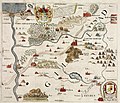 Tribe of Gad
 Tribe of Issacar
 Tribe of Judah
 Tribe of Manasse
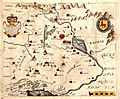 Tribe of Naphtali
 Tribe of Reuben
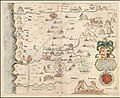 Tribe of Simeon
 Tribe of Zebulon
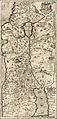 Terra Canaan and Tribes


 Texts on Wikisource:


16 Annotations
First Reading
language hat • Link
"the great Tom Fuller"
Now (according to the Companion) "best remembered for his history of English families, The history of the worthies of England (first pub. 1662)." He was a royalist and a popular preacher; Pepys "was especially fond of reading (on Sundays) his Church-history of Britain (1655)."
More (much more) can be found in the (lamentably badly scanned) 1911 Britannica entry here:
http://90.1911encyclopedia.org/F/… (scroll down); fans of James Joyce will especially appreciate the mention of his A Pisgah-Sight of Palestine (1650).
Here is the entry on him from The Cambridge History of English and American Literature in 18 Volumes (1907
vincent • Link
thanks to LH
http://www.quoteworld.org/author.…
Your friend is the man who knows all about you, and still likes you."
-- Dr. Thomas Fuller (1608-61), English clergyman, writer, "The Church History of Britain
source of interesting quotes
--------------------------------
Phil • Link
His 'Church-History of Britain': http://www.pepysdiary.com/encyclo…
vincent • Link
FULLER, THOMAS (1608-1661), English divine and historian, eldest son of Thomas Fuller, rector
a lenthy dissertatation:
http://www.bartleby.com/81/18088.…
Jenny Doughty • Link
He was born within the sound of Bow-bell.
- Gnomologia
I note this quotation from Fuller on one of the links above - does anybody know whether he was the originator of this saying, or whether he was merely repeating a maxim that was commonplace by then?
dirk • Link
He was born within the sound of Bow-bell.
I'm sorry, but this quote is from the hand of another Thomas Fuller: "Gnomologia, Adagies and Proverbs, Wise Sentences and Witty Sayings, Ancient and Modern, Foreign and British", 1732 by Dr Thomas Fuller MD(Editor) (1654-1734).
"Our" Thomas Fuller (1608-1661), clergyman, divine and historian, wrote his works somewhat earlier. His text on "The Cause and Cure of a Wounded Conscience" from 1647 can be read on:
http://justus.anglican.org/resour…
Thomas Fuller is not an uncommon name.
The **Bow-bell** is referred to in many places, i.a.:
Sir Walter Scott's "The Fortunes Of Nigel": "It is a credit to her, that, bred and born within the sound of Bow-bell, she can blush for any thing."
http://arthurwendover.com/arthurs…
and:
"Gratiae Ludentes; or, Jestes from the University." by H.L. Oxon, London, 1638: "A Scholler being about to describe one that spake very bigge, said he spake as if he had a Bow-bell in his mouth."
http://www.ucs.mun.ca/~wbarker/gr…
There must have been many expressions with "Bow-bell" around before the 1732 Gnomologia...
Glyn • Link
I mistakenly thought that Bow Bells must have been in the district of Bow in east London, but in fact the church is St Mary le Bow, which is in the heart of the City.
This is the church's website:
http://www.stmarylebow.co.uk/
with a fascinating historical account of Bow Bells:
http://www.stmarylebow.co.uk/bell…
The Rector of the Church is George Bush, and I can confirm that he is a very nice man having talked to him at one of the church's lunchtime concerts.
dirk • Link
St. Mary le Bow
A very readworthy text on St. Mary le Bow and other London churches...
"Some Lady Churches of Old London"
http://www.marysyellowstone.com/h…
dirk • Link
St. Mary le Bow cont'd
"Originally called St. Mary New Church (St. Mary Aldermary in Bow Lane was the 'Older' Church), by the Norman period this Church was called Sancta Maria de Arcubus. Arcubus refers to the arch or bow arches which were in the crypt, commemorated in the bows on top of the medieval tower.
When Wren rebuilt the church after the Great Fire or 1666, he alluded to these arches in the apire. When you go outside look up towards the tip and you can see them like little buttresses springing up and keeping this play on words, arches and bows alive."
From:
http://www.phespirit.info/cockney…
"The Court of Arches was a court of appeal belonging to the Archbishop of Canterbury, and the judge of such court was called the Dean of the Arches because in ancient times he held court in the church of St. Mary le bow (Sancta Maria de arcubus)."
From:
http://www.newadvent.org/cathen/0…
On "The Court of Arches", see:
http://www.newadvent.org/cathen/0…
Emilio • Link
Easy-to-read Fuller
The Wikipedia has republished the 1911 encyclopedia article LH links to at the top, but in proofread and much more readable condition:
http://en.wikipedia.org/wiki/Thom…
Jesse • Link
Updated link for Fuller's quotes:
http://www.giga-usa.com/quotes/au…
Michael Robinson • Link
NY Times "slide show" for the 400 anniversary of Fuller's birth:-
http://www.nytimes.com/slideshow/…
Second Reading
Bill • Link
FULLER, THOMAS An English historian and divine, was born in 1608. He was educated at Queen's College, Cambridge, where he took his degree in arts. On entering into orders, he was presented to the rectory of Broad Windsor, in Dorsetshire. He successively enjoyed several other preferments in the church, and would, probably, have been raised to a bishopric, had he not been taken off by death, in 1661. He wrote "The History of the Worthies of England," a performance of great merit, and many other valuable works. Astonishing things are reported of his memory. From once hearing a sermon, he could repeat the whole of it verbatim. He undertook, in going from Temple-bar to the farther end of Cheapside, to tell at his return every sign as it stood in order, on both sides of the way, repeating them either backwards or forwards, which he performed exactly. He was a learned, industrious, lively writer, but rather too fond of punning. He was a very corpulent man, and once as he was riding with a gentleman of the name of Sparrowhawk, he could not resist the opportunity of passing a joke upon him: "Pray, what is the difference (said he) between an owl and a sparrowhawk?" The other answered this sarcastic question as follows: "An owl is fuller in the head, fuller in the body, and fuller all over.
---Eccentric biography; or, Sketches of remarkable characters, ancient and modern. 1801.
Bill • Link
FULLER, THOMАS (1608-1661), divine; M.A. Queens' College Cambridge, 1628; perpetual curate of St. Benet's, Cambridge, 1630; prebendary of Salisbury 1631; rector of Broadwindsor, Dorset, 1634; as curate of the Savoy preached sermons from 1642 in favour of peace between king and parliament; retired to Oxford, 1643; followed the war as chaplain to Sir Ralph Hopton 1644-6; at Exeter as chaplain to the infant Princess Henrietta, 1644-6; returned to London after surrender of Exeter; chaplain to Lord Carlisle; preached in London on sufferance; rector of Cranford and chaplain to Earl Berkeley, 1658; accompanied Berkeley to meet Charles II at the Hague, 1660; after Restoration resumed his canonry and Savoy lectureship and became 'chaplain in extraordinary' to the king; published 'History of the Holy Warre,' viz. the crusades, 1643, 'The Holy State and the Profane State,' 1642; 'A Pisgah-sight of Palestine,' 1650; 'Church History of Britain,' 'History of Cambridge University,' 1655; and 'Worthies of England,' 1662.
---Dictionary of National Biography: Index and Epitome. S. Lee, 1906.
Bill • Link
These four works listed in the encyclopedia:
Fuller's 'Andronicus, or The Unfortunate Politician' http://www.pepysdiary.com/encyclo…
Fuller's 'History of the worthies of England' http://www.pepysdiary.com/encyclo…
Fuller's 'The Church-history of Britain' http://www.pepysdiary.com/encyclo…
Fuller's 'The Historie of the Holy Warre' http://www.pepysdiary.com/encyclo…
Third Reading
San Diego Sarah • Link
Thomas Fuller was born to Rev. Thomas Fuller, rector of St. Peter's in Aldwinkle, Northants,, and Judith Davenant, whose family included William Davenant, the poet laureate of England at the time, and John Davenant, the bishop of Salisbury.
http://www.enotes.com/topics/thom…
"Nothing that has been said about Fuller’s moderation must be construed into a charge against him of ... time-serving. It is true that, if not exactly ... a puritan, he was probably more definitely anti-Roman than was usual on the cavalier side.
"But he saw active service in the non-combatant way at Basing, at Oxford with Hopton and at Exeter; his London residence in 1643 gave opportunity for hardly less active exercise in the royalist cause, for several of his sermons at the Savoy were strong, and, in the circumstances, not very safe, advocacies of that cause, and of the indissolubly allied cause of prelacy.
"He publicly and, for him, pretty sharply rebuked Milton’s anonymous tractate 'Of Reformation … in England';
"was in his turn sharply taken to task by a Yorkshire puritan divine, John Saltmarsh; and was stopped (arrested) for a time by the Commons’ orders, when proceeding to Oxford with a safe conduct from the Lords. ...
'As a man, he seems to have been perfectly honest and sincere; a better Christian than most men on either side; not quite destitute, perhaps, of a certain innocent vanity and busybodiness; but without a drop of bad blood in his composition. It is, however, as a man of letters that we are here principally concerned with him."
https://archive.org/stream/histor… link from entry to Dr. Fuller's bio page)
Dr. Fuller was a corpulent man. Once as he was riding with a gentleman by the name of Sparrowhawk, he could not resist the opportunity of passing a joke upon him: "Pray, what is the difference (said he) between an owl and a sparrowhawk?"
The other answered this sarcastic question as follows: "An owl is fuller in the head, fuller in the body, and fuller all over.”
FROM Eccentric biography; or, Sketches of remarkable characters, ancient and modern. 1801.
Amazingly, no one has compiled a "complete works of" for Fuller yet, but his sermons were printed by him for distribution, and still seem to be available.
https://www.thriftbooks.com/w/the…